|
我们都知道视力不好有很多原因,比如天生遗传、不正确的用眼习惯以及很多不良的生活习惯等等。可是你知道视力不好和我们的头脑有什么关系吗?
一起来看看下面的文章的分析
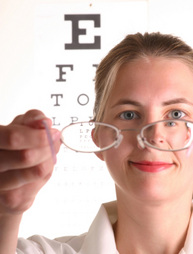
Have you been diagnosed with progressive myopia (nearsightedness), hyperopia (farsightedness), astigmatism (the asymmetric curvature of the cornea) or presbyopia (farsightedness caused by aging)? Have you been told you will have to wear glasses for the rest of your life, at least while performing certain activities? Have you been told that the body has no natural way of correcting visual defects?
If so, you’re not alone. Many people hear such definitive conclusions from their eye doctors; many believe it. But is it true? Have you ever wondered why other organs are capable of making remarkable recoveries, while the eye—our most important sensual organ—appears to be alone in lacking this power of self-correction? Why are doctors more likely to believe stories of spontaneously disappearing tumors than those of natural recovery from nearsightedness?
Eye doctors tell us that 90 percent of all people will one day have to wear glasses. Yet in my twenty years of experience as a practicing ophthalmologist, I have found that eyesight improvement is within most people’s reach. I have met and spoken to thousands of people who were the cause of their own visual improvement. The question seems not to be how “bad” one’s eyesight is, or how long the patient has been suffering from a particular problem, or what the precise nature of that problem is. Natural visual improvement mostly seems to be a mental thing rather than a matter of the eyes as such.
Ophthalmology as a rule teaches that the inability to focus properly—as in nearsightedness, for example—is caused by the shape of the eyeball. That shape is said to be genetically determined, which is why visual improvement is thought to be impossible. But if the eyeball’s inherited shape really is the cause of bad eyesight, how is it that our ancestors did not suffer the same problems? What people fail to realize is that the contemporary industrialized world is faced with an epidemic of visual defects—especially nearsightedness, which is rare in less developed countries. It appears that the number of cases of nearsightedness rises within a single generation if people are better educated and spend more time indoors. As early as 1969, researchers found that 59 percent of primary school-aged Inuit children suffered from nearsightedness, a condition that affected only 5 percent of their parents and none of their grandparents. A similar development was recorded in Japan, where the number of cases of nearsightedness nearly tripled between 1945 and 1970, in pace with the indus [1] [2] [3] [4] [5] 下一页 【已有很多网友发表了看法,点击参与讨论】【对英语不懂,点击提问】【英语论坛】【返回首页】
|