|
'Study by specialist academics is leaning towards the text being written in the 15th century.
'This was period when English was, for the very first time, being used just occasionally in preference to Latin, which was then "the norm".'
Sir Henry had been buried there in 1650 after his execution. The monument was put up in 1660 and refers to him as ending life 'kissing the axe ... to suffer the envied martyrdom of Charles I'.
Mr Tatton-Brown added: 'My guess is that it is a biblical text, put there in the Elizabethan period when the nave was fitted out with high pews for people to sit in to listen to the "new" sermons preached there.
'Inscriptions of the Bible, the Word of God, would have been written on the inside walls of the building following the Reformation, having been translated into English in Cranmer’s bible.'
Although in the 15th century the clergy stuck to Latin, English was increasingly spoken by wider society, including the ruling class.
The royal court used the language from 1413 onwards.
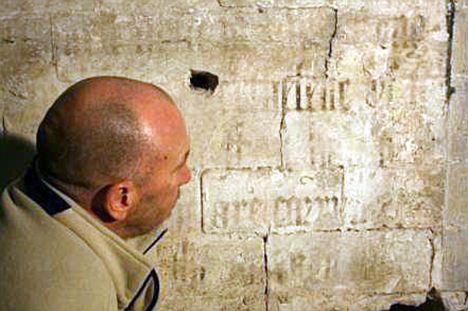
Conservator Tom Beattie examines the lettering which was revealed after a 350-year-old monument was removed
Experts in deciphering similar messages have attempt to find the meaning of the inscription but have so far failed.
Dr John Crook, who produced a digitally-enhanced image of the text, said he had found one line which read 'and we are c...' but the rest was illegible.
上一页 [1] [2] [3] 下一页 【已有很多网友发表了看法,点击参与讨论】【对英语不懂,点击提问】【英语论坛】【返回首页】
|