|
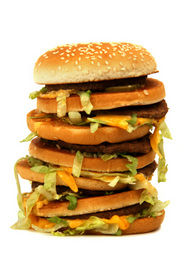
For some time now, the media has kept us aware of the link between fast-food consumption and obesity, but Morgan Spurlock’s 2004 film Super Size Me brought to our attention the other, overlooked side effects of biting into a Big Mac. Spurlock ate only food from McDonald’s for thirty days and not only experienced fat accumulation but also lost muscle mass, began to feel depressed and lethargic, and suffered from headaches. His nutritionist even pronounced him “addicted” to fast food. It seems a burger is more than just lunch these days.
Hamburger Hangover
One of Spurlock’s symptoms during the filming of Super Size Me was a recurrent, intense headache. It’s true that processed foods can trigger migraines. According to Suzy Cohen, who writes the “Dear Pharmacist” column for the Ocala, Florida, Star-Banner, processed foods, including those on the menus of fast-food joints, contain ingredients like nitrate or nitrite, monosodium glutamate (MSG), and artificial sweeteners that are all “head-bangers.”
Nitrates and nitrites are preservatives that increase blood flow, leading to head pressure and pain. Food processors add it to their meat products to protect against Clostridium botulinum, the bacteria that causes food poisoning, and because it gives the meat that fresh, pink color and “cured” taste. Makers of fast food also add MSG to enhance flavor and to hide the metallic tastes incurred while processing. These additives may make your dish more palatable, but they leave you with pretty nasty hangovers.
Down in the Dumps? Blame It on the Junk
Spurlock also complained of debilitating depression during his fast-food experiment, and research shows that junk food does indeed have an effect on mood. Researchers at University College London in England found that people who regularly ate processed foods that were high in fat and sugar were 58 percent more likely to suffer from depression than those who ate a more balanced diet, according to a study that appeared in the British Journal of Psychiatry. “There seem to be various aspects of lifestyle such as taking exercise which also matter, but it appears that diet is playing an independent role,” Dr. Eric Brunner, lead author of the study, told the Daily Mail.
Brunner and his peers concluded that relative to their calorie density, junk foods lack nutrients, like antioxidants, folate, and omega-3s, that contribute to good mental health. These important dietary elements come only from eating “wholesome foods.”
According to HealthAssist.net, certain foods and drinks act as powerful stimulants to the body and therefore contribute to stress and mood disorders. These processed foods—which contain synthetic additives like preservatives, emulsifiers, thickeners, stabilizers, and flavor enhancers—are called pseudostressors or sympathomimetics.
So it seems that fast food hits us twice when it comes to depression; we suffer from what we consume along with it, and from what we don’t.
[1] [2] 下一页 【已有很多网友发表了看法,点击参与讨论】【对英语不懂,点击提问】【英语论坛】【返回首页】
|