|
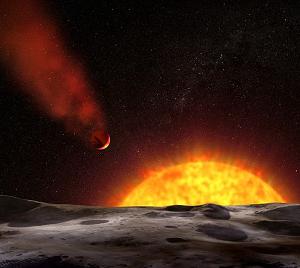
HD 209458b, shown in red in an artist's conception, is the first confirmed "cometary planet," experts say.
An alien planet orbits so close to its star that its atmosphere is being blasted away, forming a gaseous, comet-like tail, astronomers announced Thursday.
About 153 light-years from Earth, planet HD 209458b hugs its star so tightly that the planet's atmosphere is likely a scorching 2,000 degrees Fahrenheit (1,093 degrees Celsius) an a year passes in just 3.5 days—making Mercury's 88-day orbit seem downright leisurely.
That tight orbit also means this gas giant—meaning it's made primarily of gas—is subjected to blistering forces from its host star, which scientists say are the cause of HD 209458b's comet-like tail.
"This planet is getting blasted by the star and that's blowing the atmosphere off," said astronomer Cynthia Froning of the University of Colorado, who was involved in the study of the comet-like planet.
Comet-like Tail Streaming Toward Earth
HD 209458b is one of the few known transiting planets—planets that appear to periodically cross the faces of their host stars, as seen from Earth.
This means light from HD 209458b's star must pass through the planet's atmosphere before reaching us.
By studying the filtered starlight, astronomers can determine such a planet's atmospheric composition and also the direction and velocity that any gas lost to space is moving.
Using the Hubble Space Telescope's Cosmic Origins Spectrograph, astronomers recently detected evidence of a tapered gas tail streaming away from HD 209458b and toward Earth at a speed of about 22,000 miles an hour (35,400 kilometers an hour).
Comet-Like Planet to Disappear?
The most likely explanation for the comet-like feature is that the star's solar wind—actually a stream of charged particles—is evaporating the gas giant a bit at a time, astronomers say.
HD 209458b is losing about 80,000 pounds (36,000 kilograms) of mass a day—or about a billionth of Earth's mass every year, according to the new research.
Given enough time, the comet-like planet could theoretically evaporate away completely, but it would take about a trillion years. "That's longer than the life of the star," Froning said.
It's unclear how long the superheated alien world's "tail" is or how long it's been losing mass, but it's almost certain the erosion process has been happening for at least several million years, she added.
Comet-like Planets Common?
While its been speculated that stars can blast away planets' masses, HD 209458b is the "first confirmation" that atmospheric stripping is a real phenomenon, said study leader Jeff Linsky, also of the University of Colorado.
And since HD 209458b is a pretty typical "hot Jupiter"—the nickname for close-orbiting gas giants—it's "almost certain" that all hot Jupiters have comet-like tails, Linsky said.
"I think they're all going to be losing mass, and they're all inevitably going to have tails," he added. 【已有很多网友发表了看法,点击参与讨论】【对英语不懂,点击提问】【英语论坛】【返回首页】
|