|
美元是当今世界第一大货币,那么你知道美元是怎么产生的吗?
下面我们一起来看一下英文版的美元的起源The Origins of the US Dollar
Philosopher Ayn Rand once pointed out that it was Americans who coined the phrase “to make money.” Rather than seeing wealth as something looted or distributed, Rand conceived of it as being earned and produced. In America, the embodiment of financial wealth is the US dollar, also known as ‘the buck’ and ‘the greenback’. It seems fitting, then, to reflect on the origins of the dollar – both where it came from and how it evolved into the fiat currency that it is today.
Early Origins
(Squeaky Marmot)
Contrary to general assumptions, the dollar existed before the United States was an independent and unified nation. Prior to the Declaration of Independence, the Continental Congress had authorized the government to issue dollars and coins for use as widely accepted tender amongst the thirteen British colonies. The term “dollar” itself actually owes to Spanish currency of the time, specifically the eight-real coin (also known as the Spanish dollar), and U.S. dollars were used side by side with their Spanish counterparts – which were accepted as legal tender until 1857 – during colonial times. In fact, the dollar wasn’t the only monetary system vying for widespread use in colonial America. In the Dutch New Netherland (New York) colony, for example, the lion dollar was the currency of choice. However, the U.S. dollar began separating itself from the pack following a Congressional resolution on August 8, 1786.
It was Alexander Hamilton’s leadership at the treasury department, however, which truly cemented the dollar’s status as the basic unit of account in the U.S. with the passage of the Coinage Act of 1792. The act mandated that a “dollar” be between 371 and 416 grains of silver and an “eagle” be between 247 and 270 grains of gold. (An eagle was said to be with 10 dollars, and a dollar worth one-tenth of an eagle.) Here, again, we see the influence of Spanish dollars on the fledgling American currency, as Hamilton based these silver and gold weights on the average weight of worn Spanish dollars. This act also commissioned the opening of a mint in Philadelphia, then the capital of the nascent country. Incidentally, the mint was the first federal building opened with authority from the United States Constitution.
Interestingly, the practice of putting presidents on the front of U.S. dollars is a rather modern tradition, beginning only in the early 1900’s. George Washington, the president most readily identified with the dollar, scoffed at the idea of using his face on money. To Washington, the very notion smacked of European monarchical tradition. As for the ubiquitous dollar sign ($), various theories have been proposed to explain its emergence. Rand, for instance, claimed that the dollar sign represented “U” and “S” superimposed, although this theory is questionable because the dollar sign predates the formation of the U.S. as an independent nation. Other theories reference the coat of arms found on Spanish colonial currency or suggest that it is nothing but an evolved scribal abbreviation for Spanish and Mexican pesos. The latter is perhaps the most widely believed, but historians remain divided on the exact origin.
The Gold Standard
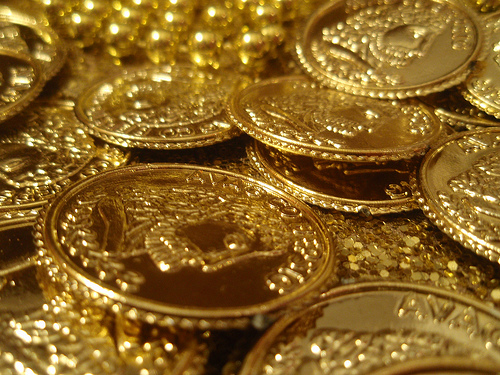
(Mykl Roventine)
[1] [2] [3] 下一页 【已有很多网友发表了看法,点击参与讨论】【对英语不懂,点击提问】【英语论坛】【返回首页】
|